
Your weather app refreshed this morning because someone’s code ran perfectly in space before you woke up. A satellite passed over a ground station. Data moved through a pipeline spanning thousands of miles. Nobody noticed. That’s the point.
We talk about internet infrastructure only when Facebook goes down. We talk about power grids only when the lights go out. Reliable systems are invisible by design. Satellite data infrastructure has quietly joined that category, and the industries depending on it, from commodity trading to disaster response to national security, rarely think about what it takes to keep it running.
The last decade of investment has produced a generation of companies that can reliably put data in orbit and get it back down. That problem, while genuinely hard, is largely solved at the level required for commercial viability. Now, the next constraint isn’t engineering, but translation.
The Engineering Bar Is Real
Reliability in space isn’t a harder version of cloud reliability. It’s a categorically different problem.
In a terrestrial data center, you reroute when a server fails, roll back a broken deployment, scale capacity when traffic spikes. The entire architecture of cloud computing assumes physical access is possible and mistakes are recoverable.
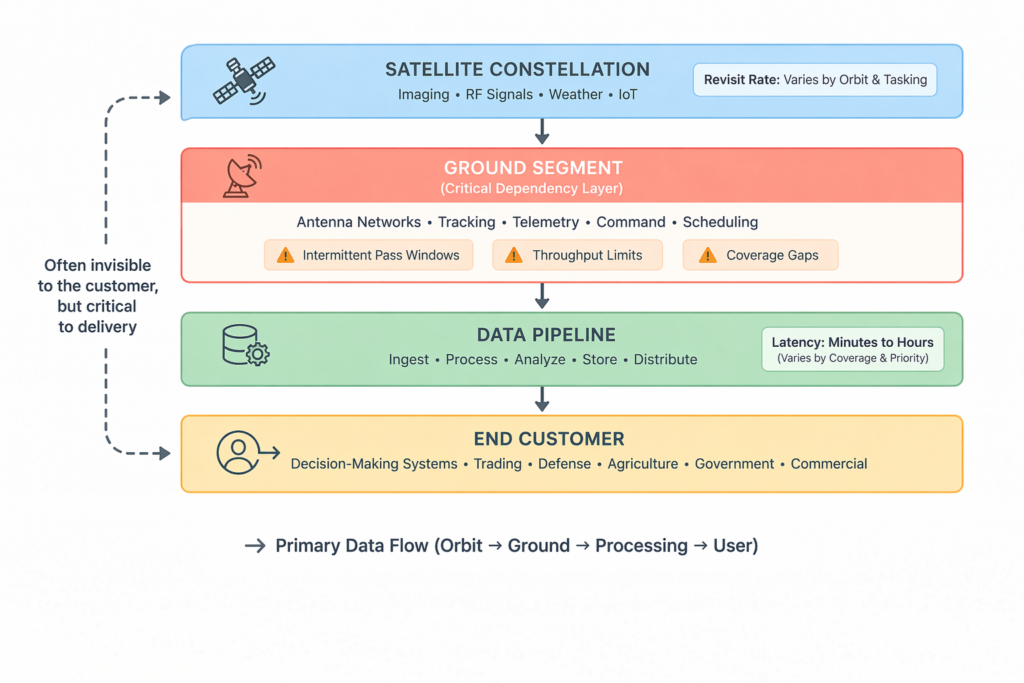
Satellite infrastructure removes all of that. There’s no patch you can push mid-orbit. No on-call engineer who can physically intervene. Fault-tolerant software has to anticipate failure modes and encode responses that can execute autonomously, without waiting for a ground command that could take hours to arrive. Ground stations receive downlinks in windows that close and may not reopen for hours, depending on constellation architecture and ground network coverage.
The ground segment itself is its own bottleneck. As Northwood Space, which is building what it describes as a ground infrastructure layer that works like cloud computing, puts it directly: “the growth in space-side capabilities has outpaced the underlying ground infrastructure that supports it.”
That bottleneck is real. And many companies have spent years solving it. Which leads us to how this question has shifted into how to properly translate all the data.
The Gap Between Data and Decision
That translation challenge shows up differently depending on where a company sits in the satellite data stack. Here’s how it looks across four of the companies defining the sector…
- Planet Labs’ mission contains three words that, when read carefully, describe two different problems: make global change visible, accessible, and actionable.
“Visible” is an engineering problem. Planet Labs’ Dove constellation images the entirety of Earth’s landmass at near-daily cadence. The engineering is genuine and significant. “Accessible” and “actionable,” however, are communication problems, and they’re where the industry’s next competitive frontier actually lives.
Near-daily imagery means something different to a trained defense analyst than it does to an agricultural operator integrating satellite data into their workflow for the first time. As Planet Labs notes, Earth observation (EO) data is playing a more central role in government operations and decision-making. That expanding role brings in buyers who are newer to satellite data, and who need more than access. They need context.
Planet Labs describes its expansion beyond traditional defense and agriculture customers as democratizing access to satellite data. Democratization requires building the translation layer that turns a revisit rate into a decision.
- For Spire Global, which designs, builds, and operates its own satellite constellation, ground stations, and software infrastructure to deliver what it describes as actionable intelligence from space, the gap sits between coverage capability and operational confidence. Spire positions its data as timely, reliable, and actionable across weather forecasting, maritime tracking, and aviation analytics.
However, the gap between “we turn space-based data into actionable intelligence” and “your trading desk can act on this before the window closes” isn’t an engineering gap. It’s a comprehension gap. Spire’s data products are built to improve situational awareness, but situational awareness still requires the customer to understand what they’re looking at, what its limits are, and when to trust it.
- For HawkEye 360, which detects, geolocates, and characterizes RF emissions worldwide for defense and national security customers, the stakes of that gap are highest. The translation problem looks different at this end of the market. Planet Labs and Spire serve commercial customers where the cost of miscommunication is primarily financial. HawkEye 360 serves national security customers where the cost can be irreversible.
In signals intelligence, wrong data isn’t just unhelpful. It’s worse than no data. A mischaracterized RF emission doesn’t just cost money, it informs a decision that can’t be reversed. HawkEye’s repeated emphasis on “trusted domain awareness” is telling precisely because trust isn’t just an engineering property. It’s also a communication property. You build it by being explicit about what your data shows, what it doesn’t, and what happens at the edge cases.
The Dependency Nobody Talks About
Northwood Space sits one layer below the data companies, and its position makes the communication problem visible in a way the data companies rarely surface for customers. “Our overall perspective on the space industry was that volume of data was going to go up, use cases were going to go up,” said Northwood founder Mendler on the reasons for founding the company. That bet has proven correct. But as data volume and use cases scale, so does the gap between what the infrastructure can promise and what customers understand they’re buying.
When Planet Labs promises near-daily delivery, when Spire Global guarantees data freshness, when HawkEye 360 commits to trusted domain awareness, there’s an assumption buried in many of those promises: that the ground segment works. Northwood is building the infrastructure that makes those promises keepable, a phased-array antenna system designed to maintain simultaneous links with multiple satellites across multiple orbits, addressing the throughput bottleneck that aging ground networks can’t handle as constellation sizes grow.
Seeing that ground infrastructure is invisible to the end customer, the dependency it creates often goes uncommunicated. The enterprise customer buying maritime intelligence doesn’t always know that data freshness varies with pass frequency and ground network coverage in their region. The government agency buying Earth observation data doesn’t always know that their delivery window is partly a function of ground station geometry.
For many contracts in this industry, that gap is still in the fine print.
The Translation Problem Is Also a Business Problem
The translation gap is becoming something companies can’t afford to ignore.
A service level agreement, or SLA, is the contract that defines what a vendor promises to deliver and what happens when they don’t. In enterprise software, that contract has a solid engineering foundation. Uptime is measurable. Latency is measurable. The commitment is specific because the system is controllable.
In satellite data, writing that contract is a product design challenge. How do you promise a revisit window when cloud cover is outside your control? How do you define “delivered” when the pipeline runs through ground infrastructure with its own availability profile? How do you guarantee data freshness when orbital mechanics determine when a pass happens?
The companies that figure this out aren’t just better at legal paperwork. They’re building a fundamentally different kind of customer relationship, one where the buyer understands what they’re getting, what the constraints are, and what reliability actually means in context.
Companies that get this right build operational trust that compounds into long-term contracts and mission-critical dependency. Companies that don’t sign contracts with customers who don’t fully understand what they bought can end up discovering the gap at the worst possible moment.
The Code That Ran Before You Woke Up
Your weather app refreshed this morning because several things held together in sequence. The stack of invisible infrastructure did what it was built to do. Nobody noticed. That’s still the point.
But the companies that define the next decade of space infrastructure won’t just be the ones keeping that stack invisible through engineering excellence. They’ll be the ones making it legible, to the commodities trader who needs to understand what data freshness means for their model, to the government agency that needs to know what’s actually in the SLA they signed, to the agricultural operator who needs to know what happens to their analysis when cloud cover breaks a three-day imaging streak.
Visible, accessible, actionable. The first word is an engineering problem. The industry solved it. The next two are harder, and the companies making progress on these problems will be the ones that matter most.
If you’ve made it this far ~ thanks for sticking around.
Disclaimer, this is just my perspective shaped by years of building and running marketing across multiple industries. What have I learned? This translation gap between infra and communication applies everywhere! And is something I’m determined to help solve.
I’d love to hear your take. Whether it’s a different pov, a question, or something this article reminded you of. Find me on X or Linkedin. Growing together beats going at it alone.